
When I first went to Iceland in June of 2013 I was interested in tracing Dad’s wartime footsteps there – something he very rarely talked about – and I wrote about what I managed to find in my blog. Here’s an example: Alfred Fox, Iceland 1940-42, some detective work finds Skipton Camp. Little did I realise at the time that I would return many years later to the site of Skipton Camp – in the summer of 2025 – on the same quest but with a whole new family context.
This story restarts in June 2024 with the delivery of a DNA kit to Falun in Sweden where we were staying with Jeannie and family. On 17 June 2024 the 23andMe ancestry service kit I had ordered was shipped to me from the Netherlands. It’s interesting to note here that if I had chosen a different ancestry service then what later transpired would never have happened. On August 7th, when we were back home in South Africa I received my genotyping results and, interesting though they were, there were no great surprises as to who I was and where my ancestors had come from. In October, however, this story continues following an intriguing dinner party conversation with our friends Sioux McKenna and Wayne Tammadge about DNA and ancestry. This inspired me to activate the option in my 23andMe website to identify my DNA relatives.

Amazingly, as I did so, Kate said that I should be careful as I might discover that I had Icelandic relatives – she knew all about my attempts to trace Dad’s footsteps as we had travelled to Iceland together in 2013. Moments later I saw that my closest DNA relative was a young lady with a characteristically Icelandic name: Gígja Teitsdóttir. 23andMe identified her as my half great niece – with a 6.71% DNA match. I was so surprised that it took me a few days, and several attempts, before I managed to compose a couple of sentences to send to her in the 23andMe message function: “Hello Gígja. I just did the family and friends option here and – to my surprise – you came out on top with 6.7%. Is it possible that this was because my dad was in Iceland from 1940-42? I’ve written about his time in Iceland here: https://roddyfox.com/2013/10/20/alfred-fox-iceland-1940-1942-preface/ but perhaps there’s far more to his story. Anyway it will be nice to get in touch with you. Best wishes, Roddy”
Eventually , eleven days later, I got a reply. I had been wondering whether Gígja had seen my message, or maybe she didn’t want to answer, I didn’t know why she had done a DNA test and so there could be many reasons why I hadn’t heard from her. She responded: “Hey Roderick, thank you for messaging me, really nice to hear from you. I apologize for the late reply, I needed to look into this information a little bit before replying back. The thing is that this information is really big for my family. I am going to give you the short version and then refer you to my uncle Árni for a longer, deeper conversation … The reason these news are so big for my mother’s siblings is that my grandmother, their mother, never knew who her father was. She was born in 1941 in Reykjavik…”
And so the story continues that leads onwards through the discovery of 51 relatives to our walk across from Austurbæjarskóli to Hallgrímskirkja in central Reykjavik on 26 June 2025 with my nephews Árni and Óli, my niece Rut and great niece Inga María (Óli’s daughter). They were all descended from María, Dad’s daughter, who was the older sister I never knew but whose life I now wanted to trace.
Gígja had put me in touch with her uncle Árni (my nephew) and I soon discovered from him that María was born on March 9, 1941. This is almost exactly nine months after the midsummer of 1940, so Dad had only been in Iceland for a few weeks when he met María’s mother Guðrun Theodórsdóttir – perhaps at a midsummer dance as Árni suggested. Guðrun had a turbulent lifestyle – the seventh of twelve children born into poverty – and was 17 years old when she must have met Dad. Árni subsequently wrote to me about Ástandið (the Situation): referring to the shame and social condemnation resulting from the relationships between Icelandic women and British and American soldiers during World War II. He told me that, to protect her honor, Guðrun had claimed that a lawyer, Ólafur Guðmundsson, was María’s father – though he did not acknowledged this. Rut also told us, when we were staying with her in Reykjavik, that Guðrun had several lovers. And now we know, through the DNA match with Gígja, that my Dad was María’s father though Dad never gave any hint that he had a daughter and we will never know if he knew about María.
Maria had six children: Rut (who we stayed with on our visit this year), Árni, Ólafur, Theodóra (whose home on Hrísey we also stayed in), Elin and Gunnar. She had an unstable and unhappy life marred by alcoholism and abuse that tragically led to all of her children being taken from her. She died in 2004. We met her eldest four children for the first time in June 2025 when we flew to Iceland and happily they have all done well and broken free of the vicious circle of previous generations. They all did the same DNA test through 23andMe and that gave us full confirmation that Alfred Fox was their grandfather. They were the most welcoming hosts that you could ever imagine. Árni is an historian and, following extensive communication with me and sharing Dad’s Iceland photos, he became our guide to Skipton Camp – and other locations in and around Reykjavik of family interest.
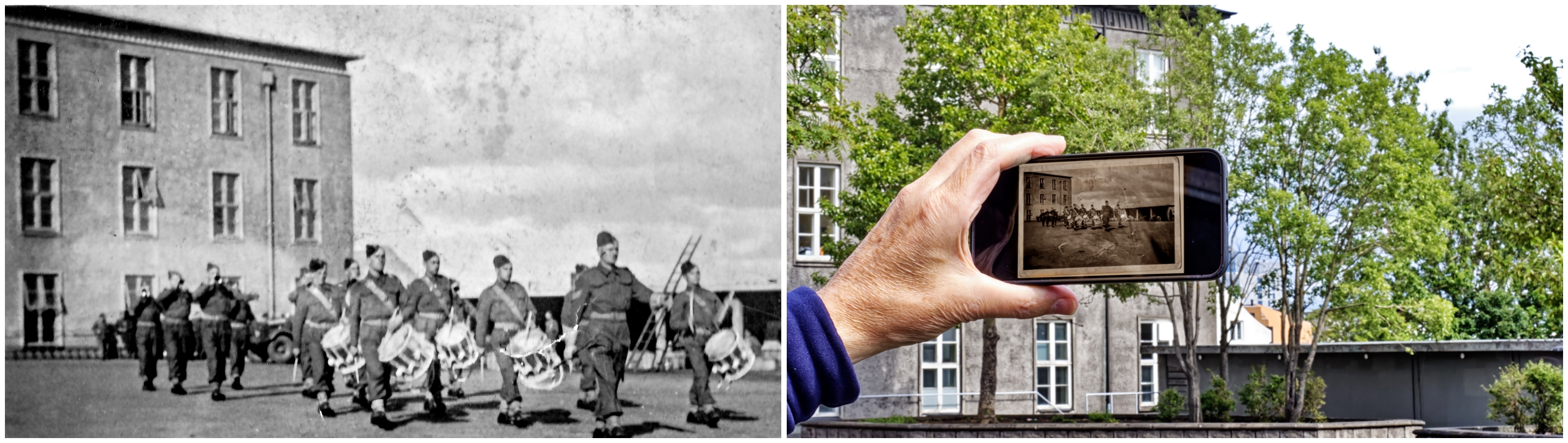
So here is Austurbæjarskóli – where Dad had kept a number of photographs – and as you can see Árni had found the exact location of two of them. Here’s the picture of the band marching out across the parade ground on Árni’s phone in the exact position the original must have been taken. The second shot of Dad and one of his mates also has the school in the background. It was taken a little further away on Barónsstigur looking back up towards the school buildings that had, as all of them were, been requisitioned by the army through the occupation period.

If you then walk across – as we did – from Austurbæjarskóli through the car park to the public space between the statue of Leif Erikson and the church: then this is the whole area that was occupied by Skipton Camp – where Dad had lived in 1940 and 1941.

And here , for now, we can leave him and the new family that we met for the first time in the summer of 2025.
 Sun Downer Blogs
Amazing what a brief encounter abroad can yield, not least in terms of fascinating other encounters 85 years later. I haven’t done a genetic test, but I am motivated now, not least because my father spent most of the war unmarried (but engaged) in India!
Absolutely fantastic Roddy what a wonderful story …..